
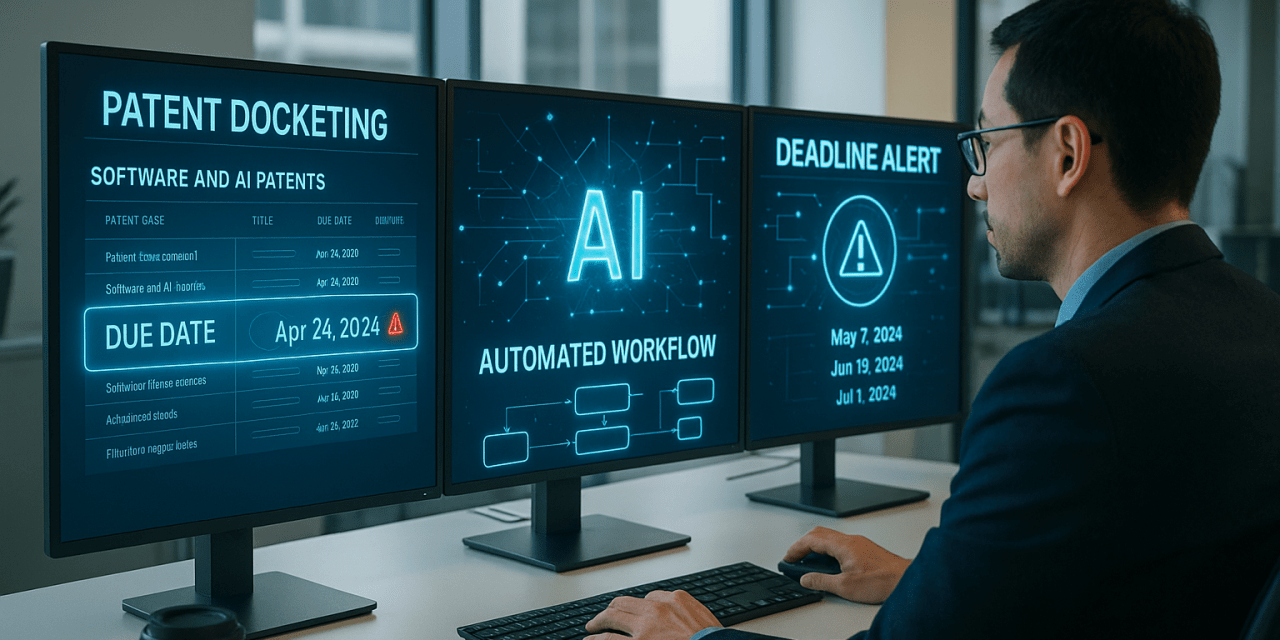
Introduction to AI Docketing Services in IP Management
In today’s fast-paced intellectual property landscape, law firms and in-house IP teams managing software and AI patents face increasing docketing complexity and deadline sensitivity. AI docketing services offer a technology-driven solution to enhance accuracy, reduce manual errors, and optimize patent prosecution workflows. This article examines the benefits, integration strategies, and best practices for leveraging AI docketing services to protect software and AI innovations efficiently.
For authoritative filing basics, review the USPTO patent basics guide when mapping portfolio software to your patent workflow.
The Unique Challenges of Software and AI Patent Protection
First, Software and AI patents present distinct docketing challenges stemming from rapidly evolving technologies, frequent office actions, and complex deadlines associated with multiple jurisdictions. Key challenges include:
- High volume of filings: Software and AI portfolios often involve numerous applications and continuations requiring meticulous tracking.
- Dynamic prosecution workflows: Frequent amendments and responses increase docketing workload.
- Complex deadline structures: Multiple overlapping deadlines and statutory timelines heighten missed-deadline risks.
- Technical nuances: Accuracy in claim interpretation impacts docketing precision.
How AI Enhances Patent Docketing Accuracy and Efficiency
Next, AI docketing services leverage natural language processing, machine learning, and automation to analyze patent documents, extract critical dates, and flag deadlines with superior accuracy. Benefits include:
- Automated deadline extraction: AI identifies key prosecution dates from USPTO communications and automatically updates docketing systems.
- Error reduction: Minimizes human input errors common in complex software patent filings.
- Real-time alerts: AI-driven notifications enable proactive deadline management.
- Data consistency: Ensures uniformity across multiple docketing platforms and teams.
For example, a docketing manager at a mid-size law firm utilizing AI services reported a 40% decrease in missed deadlines related to complex software patent office actions within six months.
Integrating AI Docketing into Existing Patent Prosecution Workflows
For example, Successful AI docketing adoption requires seamless integration with existing IP management systems. Consider the following steps:
- Evaluate compatibility with current docketing software and patent databases.
- Define data input/output standards to ensure smooth interoperability.
- Train docketing staff on AI tool functionality and exception handling.
- Establish escalation protocols for flagged discrepancies.
Also, Use of APIs and middleware solutions can facilitate data synchronization between AI docketing platforms and internal IP software suites.Related reading: Integrating Docketing Systems with IP Software
Preventing Missed Deadlines with AI-Driven Alerts and Automation
Meanwhile, Missed deadlines can be costly and damage client trust. AI docketing services mitigate this risk by:
- Automatically generating calendar reminders and alerts tailored to software and AI patent prosecution timelines.
- Cross-referencing deadlines against procedural changes or new office actions.
- Providing dashboard visibility for docketing managers to track upcoming critical dates.
Below is a checklist for effective missed-deadline prevention using AI docketing:
| Checklist Item | Description |
|---|---|
| Deadline Extraction Accuracy | Confirm AI correctly reads and inputs all deadline data from office actions. |
| Alert Configuration | Set up multi-level notifications for approaching deadlines. |
| Exception Monitoring | Implement review processes for docketing anomalies flagged by AI. |
| Backup Procedures | Maintain manual verification protocols as fail-safes. |
| Staff Training | Ensure docketing teams understand AI system alerts and responses. |
Related reading: Missed Deadline Prevention Strategies
Outsourcing vs. In-House AI Docketing Solutions: Pros and Cons
In addition, Law firms and corporate IP teams must weigh the benefits of outsourcing AI docketing services versus building internal capabilities.
| Aspect | Outsourced AI Docketing | In-House AI Docketing |
|---|---|---|
| Cost | Variable fees; avoids upfront software investment. | High initial setup costs; ongoing maintenance expenses. |
| Expertise | Access to specialized docketing experts and AI tools. | Requires staff training and AI expertise development. |
| Control | Less direct control over data and processes. | Full control over docketing workflows and data security. |
| Scalability | Easily scalable for fluctuating workloads. | Limited by internal resources and staffing. |
| Integration | May require data exporting/importing steps. | Better integration with existing IP systems possible. |
Related reading: Outsourced Patent Docketing Services
Case Study: Improving Software Patent Workflow with AI Docketing
However, A leading technology law firm integrated AI docketing services into their software patent prosecution practice. Key outcomes included:
- Reduced manual docketing errors by 50% within the first quarter.
- Improved coordination between prosecution and docketing teams through shared AI dashboards.
- Enhanced client reporting accuracy regarding upcoming deadlines.
- Streamlined handling of complex office action responses.
As a result, This case underscores AI docketing’s potential to drive operational excellence in software patent management.Related reading: Patent Prosecution Workflow Best Practices
Best Practices for Law Firms and In-House Teams Using AI Docketing
- Conduct thorough vendor due diligence: Evaluate AI docketing providers for accuracy, security, and support.
- Standardize docketing protocols: Align AI extraction outputs with firm or corporate docketing standards.
- Implement continuous training: Keep teams updated on AI capabilities and workflow changes.
- Regularly audit AI performance: Monitor for missed deadlines or inaccuracies.
- Maintain human oversight: Use AI as an augmentative tool, not a replacement for experienced docketing professionals.
Frequently Asked Questions
What are AI docketing services in patent prosecution?
AI docketing services use artificial intelligence technologies like natural language processing and machine learning to automate the extraction and management of patent prosecution deadlines, aiming to improve accuracy and efficiency.
How can AI improve accuracy in software patent docketing?
AI reduces human error by automatically parsing office actions and correspondence to extract deadlines and critical dates, ensuring consistent and precise docket entries tailored to the complexities of software patent prosecution.
What are common challenges in managing AI patent deadlines?
Challenges include rapidly changing prosecution timelines, multiple overlapping deadlines, technical nuances affecting claim interpretation, and coordinating across jurisdictions.
Can AI docketing systems integrate with existing IP management software?
Yes, many AI docketing platforms support integration via APIs or middleware to synchronize data with established IP docketing and management systems, enhancing workflow continuity.
Is outsourcing AI docketing support beneficial for in-house teams?
Outsourcing can provide access to specialized AI expertise, scalability, and cost efficiencies, though it may involve less direct control over processes compared to in-house solutions.
This article is for informational purposes only and does not constitute legal advice.
Conclusion
At the same time, AI docketing services represent a strategic advancement for law firms and in-house IP teams managing software and AI patents. By enhancing accuracy, automating complex deadlines, and integrating seamlessly with existing workflows, AI-driven docketing minimizes risks and drives operational efficiency. Whether choosing in-house integration or outsourcing, adopting AI docketing is essential to prevent costly missed deadlines and maintain competitive IP prosecution practices.
Finally, Schedule a consultation with IP Docketers to optimize your patent docketing workflow using AI-driven services and prevent costly missed deadlines.
Related reading: Automation in IP Docketing
Practical Next Steps
First, Map every active docketing system, identify where deadlines are entered or reviewed, and confirm which team owns the final QA check before critical prosecution dates.
Next, Teams should also review escalation paths, audit reporting, manual override controls, and system integrations so operational risk is reduced before the next deadline spike.




Leave A Reply
You must be logged in to post a comment.